Updated: July 2026
The Best Banda Diving Sites: A Conditions and Marine Life Guide
Five named sites. Different conditions. Different rewards.
Banda Sea diving sites guide for divers planning a 7-10 day voyage.
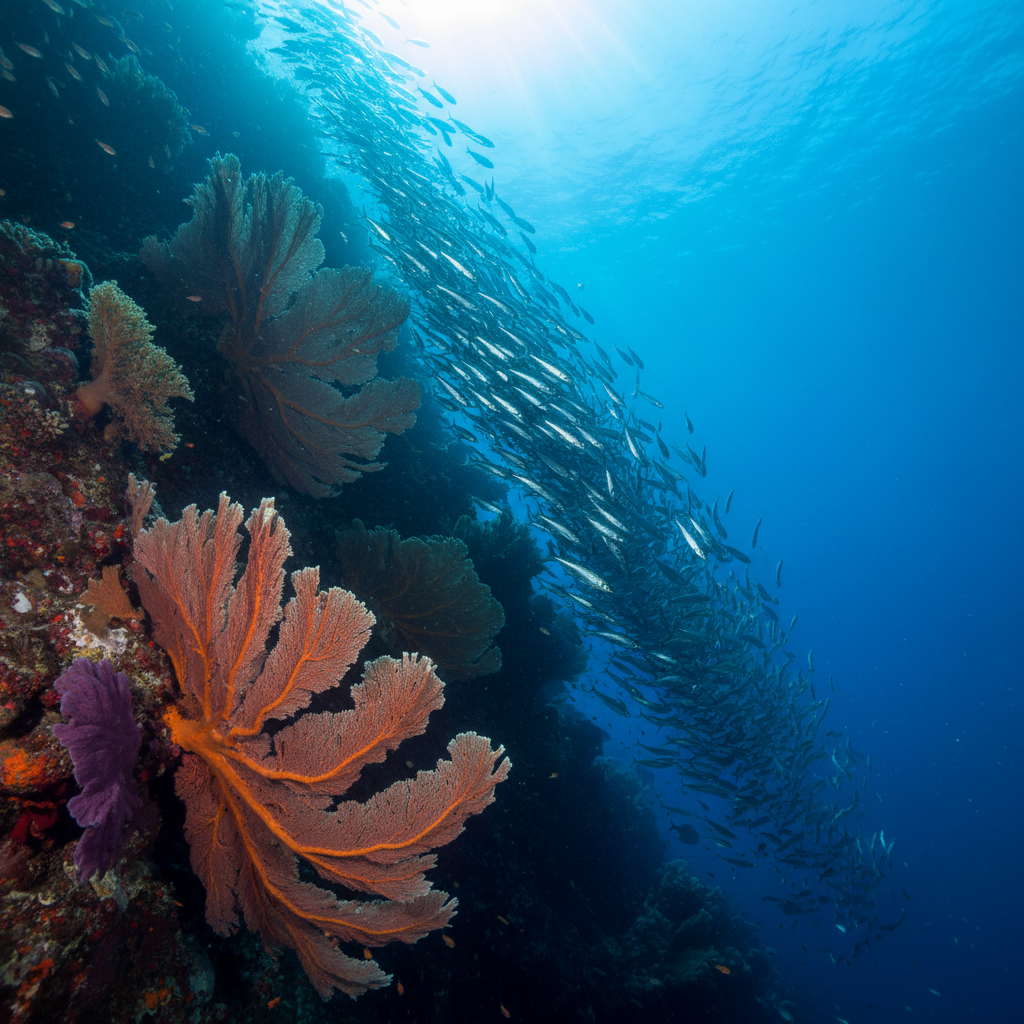
The Banda Sea has roughly 30 named dive sites across the archipelago. Most operators rotate among the same five core sites — they reliably produce the marine life that justifies the journey. Here are the five we run, with conditions and what each rewards.
1. Mt. Api lagoon (volcanic reef)
The submerged crater of Mt. Api volcano. Black sand floor, dramatic basalt formations, hot-spring vents at 18m. Surreal landscape; you can see the underwater volcanic activity in real time. Visibility 20-25m typical. Easy diving, 5-25m depth, no current. Marine life includes mandarinfish, frogfish, scorpionfish hiding in volcanic crevices.
2. Banda Besar — schooling barracuda
East side of Banda Besar (the main island). Drift dive along a wall, current moderate (1-2 knots). At 18-25m depth, schools of 200-400 chevron barracuda hover in current. October-March is peak. Visibility 25-35m.
Photography note: barracuda formations are best at midday with sun directly overhead. Wide-angle lens essential.
3. Pulau Hatta — soft coral garden
A small island 30 km southeast of Banda Neira. Wall dive 5-40m, dense soft coral covers vertical surfaces. Some of the highest coral biodiversity counts in Indonesia. Visibility 30-40m typical. Pelagic action: yellowfin tuna, occasional reef sharks at deeper portions.
4. Pulau Run — pelagic action
The famous “Manhattan-traded” island. Western wall drops to 600m+ within 50m of shore. Strong currents (2-3 knots typical), advanced divers only. Hammerhead schools regular October-November, occasional pelagic thresher shark sightings. Visibility 25-35m.
This is the most challenging dive in our standard rotation. Surface intervals are mandatory (the boats anchor in lee of the island).
5. Pulau Ai — house reef
Small uninhabited island, easy anchorage. House reef from 5-30m, gentle slope, no current. Best for night diving — the bioluminescence in Banda waters is exceptional, and Pulau Ai has the cleanest sand floor for spotting after-dark macro: stargazers, cuttlefish, octopus, juvenile fish.
Best season for diving
October-April. November-March is peak (visibility 30-40m, calm seas, full pelagic action). Plan around the new moon for best macro photography (less ambient light improves bioluminescent contrast). Full moon weeks have stronger currents — exhilarating for advanced divers, possibly intimidating for the newer ones.
Match dives to your level
Our voyages dive 12-15 of these sites total over 8 diving days. We match each guest to appropriate sites based on certification level + experience.
The Enduring Legacy of Banda Spice: History and Culture Above the Waves
While the vibrant underwater world undeniably captivates divers, the very air of the Banda Islands, infused with the faint, sweet scent of nutmeg, whispers tales of a dramatically rich and often tumultuous past that shaped global history. These eleven small volcanic islands, set in the center of the Banda Sea, were once the sole source of nutmeg and mace, spices so coveted they ignited centuries of fierce competition among European powers. For luxury travelers seeking more than just pristine reefs, understanding this profound historical backdrop enriches every moment spent on the surface, connecting the “Banda spice” legacy to the present-day tranquility.
The allure of these aromatic kernels drew adventurers, merchants, and empires to this remote archipelago. From the early 17th century, the Dutch East India Company (VOC) fought relentlessly to establish and maintain a monopoly over the spice trade, a pursuit that led to significant historical events and the construction of formidable fortresses. Fort Belgica on Banda Neira, a magnificent pentagonal structure, stands as a stark and beautiful testament to this era, offering panoramic views that sweep from the azure sea to verdant nutmeg plantations. Exploring its ramparts and dungeons provides a tangible connection to the immense value placed on “Banda spice” centuries ago, when a pound of nutmeg could be worth more than a pound of gold in Europe.
Today, the islands retain a captivating blend of influences, a legacy of traders, colonists, and indigenous communities. Strolling through the quiet streets of Banda Neira, visitors encounter elegant colonial architecture, ancient mosques, and charming local markets where fresh nutmeg and mace are still sold. This unique cultural , combined with the islands’ natural beauty, offers a profound sense of discovery that extends far beyond the dive sites. It’s a journey into a living museum, where the historical significance of “Banda spice” continues to resonate, providing a deeper context to the serene beauty experienced by luxury travelers.
Planning Your Luxury Dive Journey to the Banda Sea
Embarking on a dive expedition to the Banda Sea is an adventure into one of the planet’s most pristine and remote marine environments, demanding careful planning to ensure a truly luxurious and seamless experience. The optimal windows for visiting are typically from October to November and again from March to April. During these transitional months, the seas are generally calm, offering exceptional visibility often exceeding 30 meters (approximately 100 feet), and the weather is idyllic for both diving and above-water exploration. Traveling outside these periods can present rougher conditions due to monsoonal winds, making access and comfortable diving more challenging.
For the discerning diver, a luxury liveaboard cruise is the quintessential way to explore the Banda Sea. These opulent phinisi yachts, often handcrafted by master shipbuilders and outfitted with every modern comfort, provide access to the most remote and untouched dive sites, far from any land-based infrastructure. Journeys typically range from 7 to 12 nights, allowing ample time to immerse oneself in the diverse marine ecosystems, from vibrant coral gardens to dramatic volcanic drop-offs. Access to the Banda Islands is primarily via domestic flights to Ambon (AMQ), often connecting through major Indonesian hubs like Jakarta or Bali, with the flight from Jakarta to Ambon taking approximately 3 hours and 30 minutes.
While the Banda Sea offers sites suitable for various skill levels, many of the more exhilarating dives involve drift diving in currents and exploring deeper reefs, making it an ideal destination for experienced open water divers and advanced certified divers. Reputable luxury operators provide highly skilled dive guides who are intimately familiar with the local conditions and marine life, ensuring both safety and an enriching experience. It is advisable to book these exclusive expeditions well in advance, often 12-18 months, as the limited number of high-end liveaboards and the specific seasonal windows mean berths fill quickly. Packing light, breathable clothing, reef-safe sunscreen, and a good quality camera to capture both the underwater spectacle and the historical charm of the islands is recommended for an memorable journey.
Conservation and the Future of Banda’s Underwater Eden
The biodiversity and pristine condition of the Banda Sea’s reefs are its remote location and, increasingly, to dedicated conservation efforts that safeguard this underwater Eden. Recognized as part of the Coral Triangle, the global epicenter of marine biodiversity, the Banda Sea features an astonishing range of marine life, including over 500 species of coral and thousands of fish species. Protecting this delicate ecosystem is paramount, and local communities, government agencies, and luxury tourism operators are collaboratively working to establish and enforce marine protected areas (MPAs) and sustainable practices to ensure its long-term health.
These conservation initiatives focus on several key areas: regulating fishing practices, monitoring coral health, and educating both locals and visitors about the importance of marine stewardship. The result is a thriving underwater world where divers regularly encounter schooling hammerheads, majestic manta rays, and an incredible variety of macro life, including the elusive mandarin fish and numerous nudibranch species. The commitment to preserving these habitats means that the vibrant colors and teeming life observed on a dive today are likely to remain for future generations, making every visit a contribution to its enduring beauty.
As luxury travelers, our role in supporting these conservation efforts is significant. Choosing operators committed to eco-friendly practices, respecting marine life by maintaining excellent buoyancy control, and refraining from touching or collecting anything from the reef are fundamental responsibilities. Many luxury liveaboards actively engage in citizen science programs, allowing guests to contribute to coral monitoring or marine life identification. By consciously engaging with sustainable tourism, visitors to the Banda Sea help ensure that this extraordinary blend of “Banda spice” history and natural splendor continues to thrive, offering an enriching and responsible travel experience for years to come. Learn more about the Banda Islands’ natural wonders on indonesia.travel.