Updated: July 2026
Fort Belgica Walking Tour: A 90-Minute History Walk Through Banda Neira
Five sides. Two centuries. Banda’s most photographed monument.
Fort Belgica is the centerpiece of any Banda Neira visit. Here’s the walking tour.
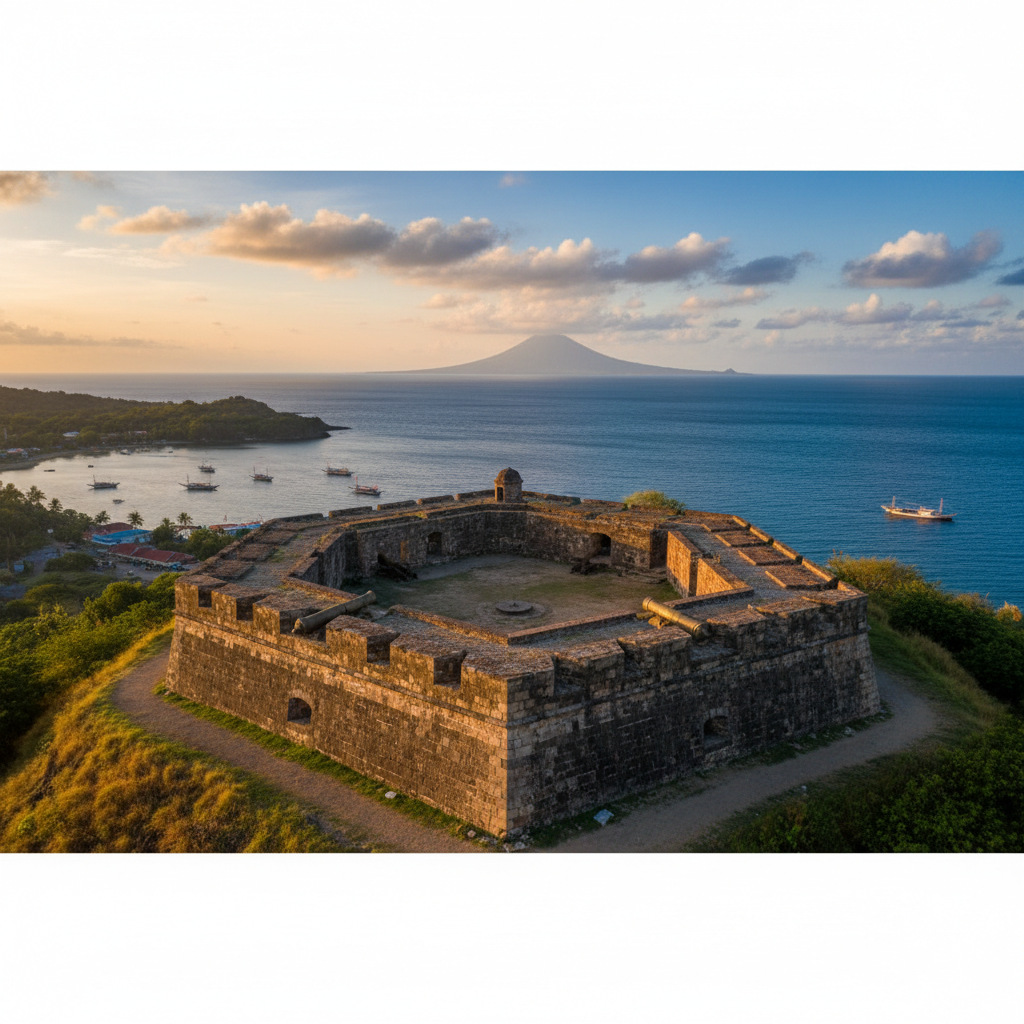
Fort Belgica was built in 1611 by the Dutch East India Company on the highest point overlooking Banda Neira harbor. Pentagonal, two-story, originally garrisoned by 50-80 soldiers. It was the administrative center of the Banda nutmeg monopoly for two centuries.
The building was extensively restored in 1991 by the Indonesian government. Today it functions as a heritage museum and free public space. The walking route below takes 90 minutes and covers what matters.
Stop 1: Approach + outer wall (15 min)
Walk up the cobbled path from the harbor — about 8 minutes from the dock. The fort sits 40m above sea level. Pause at the gate to read the small bilingual signboard giving the construction history. Note the masonry: locally-quarried volcanic stone bound with lime mortar that included crushed coral.
Stop 2: Inner courtyard (20 min)
Step through the main gate into the central courtyard. The five bastions — one at each corner of the pentagon — held the cannons. Look for the 17-century stone ovens used by the garrison cooks; the largest is in the southwest corner, signed “DAPUR”.
Climb the stairs to the upper level. The ramparts walk gives a continuous loop along all five bastions, with views in different directions: Mt. Api volcano, the harbor, Banda Besar, the open Banda Sea.
Stop 3: The northeast bastion + cannons (20 min)
The northeast bastion is the most photographed corner. Three original cannons remain in place, pointing toward the harbor entrance. Each weighs roughly 2 tonnes; the carriage wood is replaced periodically but the iron barrels date to the early 1700s.
From this bastion you can clearly see Pulau Run on the western horizon, ~30 km away. The 1667 Treaty of Breda made that island Dutch in exchange for Manhattan. From here it looks small.
Stop 4: Indoor museum (25 min)
Inside the central building (formerly the garrison commander’s quarters), a small museum displays:
— Original VOC company seal and trading documents (under glass)
— Maps showing the trading routes circa 1650
— Examples of nutmeg + mace processing equipment
— Photographs of pre-restoration ruin (1980s) for contrast
Captions in Indonesian and Dutch. Our historian provides English commentary.
Stop 5: Sjahrir house + descent (10 min)
Exit through the main gate, take the path that leads down through the back of the fort. Within 5 minutes you’ll reach the Sjahrir House — a colonial-era residence where the Indonesian socialist intellectual Sutan Sjahrir was exiled in the 1930s. Sjahrir later became Indonesia’s first prime minister. The house is now a small museum, opens 09:00-12:00 most days.
Practical notes
Open 08:00-17:30 daily. Entry free. No photography restrictions. Wear sturdy shoes (cobbled paths are uneven). Bring water — the rampart walk is exposed in midday sun. Toilets at the entrance only.
Walk the fort with us
Our day-3 visit to Banda Neira includes a 2-hour Fort Belgica tour with our historian. Indoor lecture afterward, dinner with the Wattimena family in the evening.
Beyond the ramparts: The enduring legacy of Banda’s spice trade
The air on Banda Neira still carries the faint, ghosted scent of nutmeg and mace, a sensory echo of the island’s profound historical significance. While your Fort Belgica walking tour provides a tangible connection to the Dutch colonial era, it’s merely one chapter in a saga written by the insatiable global demand for banda spice. For centuries, these tiny volcanic islands were the sole source of nutmeg and mace, commodities so valuable they fueled empires and sparked brutal conflicts. The allure of these aromatic kernels drew adventurers, merchants, and ultimately, conquerors from across the globe, transforming Banda Neira into a pivotal geopolitical stage.
The 17th century marked the zenith of Banda’s spice trade, when the Dutch East India Company (VOC) solidified its monopoly, leading to an era of immense wealth for the company but also unimaginable hardship for the local Bandanese. In 1621, Jan Pieterszoon Coen, then Governor-General of the VOC, orchestrated a massacre that decimated the indigenous population, effectively seizing complete control of the precious spice groves. This dark chapter underscores the immense power wielded by nutmeg and mace, transforming these islands into the world’s first truly globalized commodity market. Understanding this complex history enriches every step you take on Banda Neira, offering a poignant backdrop to the serene beauty you witness today. The very ground beneath your feet whispers tales of ambition, trade, and the immense value placed on these exotic flavors that once commanded prices rivaling gold.
Today, the nutmeg plantations still thrive, albeit in a more peaceful coexistence with the islanders. Visitors can walk through these groves, touching the leathery leaves, observing the fruit, and seeing how the mace, a vibrant red aril, encases the nutmeg seed. This direct experience offers a unique insight into the source of the world’s most coveted spice, a journey that luxury travelers often seek. Beyond Fort Belgica, the remnants of Dutch colonial architecture, including stately mansions and a charming church, serve as silent witnesses to this dramatic past, inviting deeper exploration into a heritage that continues to define the island’s identity and allure. For a deeper the historical context, the Dutch East India Company (VOC) played a monumental role in shaping this history.
A mosaic of cultures: Experiencing Banda Neira today
While the Fort Belgica tour offers a structured glimpse into history, Banda Neira itself is an open-air museum, a living woven from its rich past and vibrant present. Beyond the fort’s ancient walls, the island unfolds into a captivating blend of natural beauty and cultural intrigue, perfectly suited for the discerning luxury traveler. The tranquil harbor, often dotted with traditional wooden boats, reflects the towering silhouette of Gunung Api, an active volcano that periodically reminds residents of nature’s raw power. This dramatic landscape invites exploration, from leisurely strolls through the town’s charming streets to more adventurous excursions.
For those seeking aquatic wonders, the waters surrounding the Banda Islands are an absolute revelation. Renowned for their pristine coral reefs and abundant marine life, they offer some of Indonesia’s most rewarding snorkeling and diving experiences. Imagine drifting above vibrant coral gardens, encountering schools of colorful fish, and perhaps even spotting larger pelagic species. The archipelago comprises 11 islands, each with its own unique charm, from the historical significance of Pulau Ai to the untouched beauty of Pulau Hatta. Many luxury itineraries include private boat charters to these outlying islands, allowing for secluded beach picnics, snorkeling, and a chance to truly disconnect. These personalized excursions highlight the region’s commitment to high-end tourism, ensuring an intimate and memorable connection with the natural world.
The cultural experience extends to the local cuisine, where the legacy of banda spice is evident in every dish. Freshly caught seafood, infused with local herbs and, of course, nutmeg and mace, offers a distinct culinary journey. Engaging with local artisans, who continue traditional crafts, provides another layer of cultural immersion. From the gentle rhythm of daily life to the warm hospitality of the Bandanese people, the island offers a profound sense of place that resonates deeply. This blend of historical depth, natural splendor, and authentic cultural encounters positions Banda Neira as a distinctive destination within Indonesia’s luxury tourism landscape, far removed from the more crowded tourist hubs.
Curating your Banda Neira luxury itinerary
Crafting a luxury escape to Banda Neira is about more than just booking flights; it’s about curating an experience that blends historical enlightenment with comfort and personalized adventure. Given its remote charm, reaching Banda Neira often involves a multi-leg journey, typically via Ambon. While commercial flights connect Ambon to Banda Neira, a private charter plane or luxury yacht from Ambon can elevate the journey, transforming transit into an exclusive part of your adventure. The flight from Ambon to Banda Neira takes approximately 30 minutes by small plane, offering striking aerial views of the archipelago as you descend into this historical haven.
Accommodation options on Banda Neira, while not as numerous as in Bali, prioritize character, history, and bespoke service. Boutique guesthouses housed in meticulously restored colonial buildings offer an intimate glimpse into the island’s past, often featuring antique furnishings and personalized attention. For those desiring ultimate privacy, a private villa rental, complete with dedicated staff and remarkable ocean views, provides an exclusive sanctuary. These luxury properties often arrange bespoke tours, from private culinary classes focusing on banda spice to guided heritage walks with local experts who bring the island’s stories to life.
To truly experience in the Banda Neira experience, consider extending your stay beyond the typical 90-minute Fort Belgica tour. A minimum of three to five days allows ample time to explore the fort, wander through nutmeg plantations, the vibrant underwater world, and engage with the local culture. Your luxury travel advisor can arrange private boat excursions to neighboring islands for snorkeling, diving, or simply lounging on secluded beaches. They can also facilitate unique encounters, such as private cooking demonstrations or meetings with local historians. This meticulous planning ensures that every moment on Banda Neira is not just a trip, but a meticulously crafted journey through history, nature, and authentic Indonesian luxury. For more travel inspiration and information on the region, visit Indonesia.travel’s Banda Islands page.