Updated: July 2026
Nutmeg Trade History: The Banda Islands That Made and Broke Empires
Why Holland traded Manhattan for one Banda island.
The most consequential trade in colonial history happened over a 3 km² island in the Banda Sea. Here’s why. (See Treaty of Breda 1667 for context.)
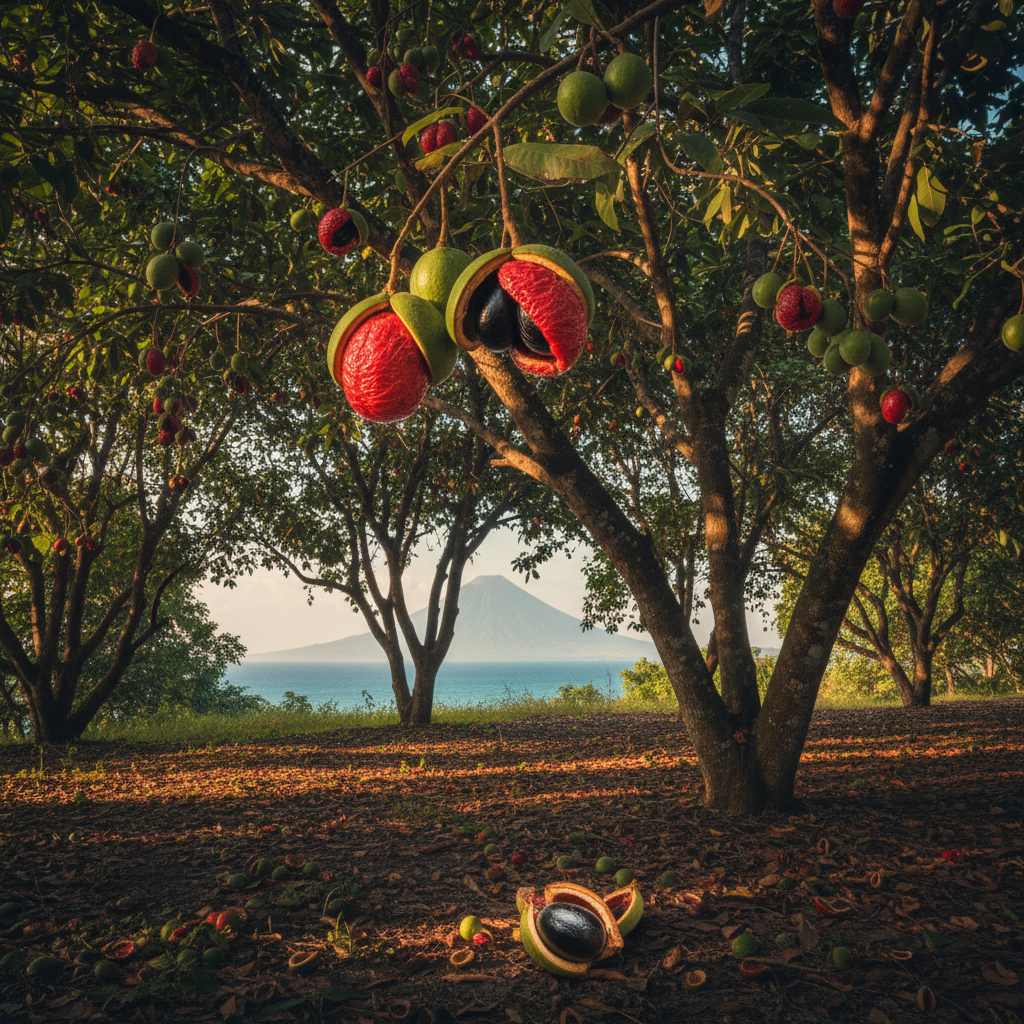
In 1667, the Dutch and English signed the Treaty of Breda ending the second Anglo-Dutch War. Both sides made concessions. The English gave up Run Island in the Banda Sea. The Dutch gave up New Amsterdam — the Manhattan colony they had founded forty years earlier. Both sides went home satisfied.
Three centuries later, the math looks puzzling. New York City is now the world’s financial capital; Run Island has 380 inhabitants and no electricity until 2018. How could the Dutch have made the better deal?
The economics of nutmeg in 1667
Nutmeg in 1667 was worth more by weight than gold. The Banda Islands were the only place in the world where nutmeg trees grew naturally — they wouldn’t be successfully transplanted out until 1817, when the French finally smuggled seedlings to Mauritius.
Run was one of ten Banda islands that produced nutmeg. By controlling all ten, the Dutch could maintain a global monopoly: cap supply, control price, capture all economic surplus. England had been the spoiler — by holding Run, they had a foothold in the trade and could break the cartel. The Treaty of Breda removed that spoiler.
For the next 150 years, Dutch nutmeg margins were 60-90% — among the highest in commercial history. The VOC (Dutch East India Company) became the world’s first publicly-traded multinational, with peak market capitalization (inflation-adjusted) larger than today’s Apple.
What the deal looked like at the time
The Manhattan colony was, in 1667, a struggling Dutch outpost — about 1,500 people, modest fur trade, harsh winters. Land was abundant in North America and would only become valuable centuries later. The English were getting a frontier town with no immediate cash flow.
Run Island was a money printer. The Dutch were getting the asset they had spent 60 years and three wars trying to acquire. From their perspective, they had won the trade.
The 1621 Banda Massacre
The Banda story has darker chapters. In 1621, VOC governor Jan Pieterszoon Coen — frustrated by Bandanese reluctance to sell only to the Dutch — ordered the systematic killing or deportation of the islands’ indigenous population. Of approximately 15,000 Bandanese, ~13,500 died or were deported within months. Coen’s surviving correspondence justified it on commercial grounds.
The depopulated islands were redistributed to Dutch perkeniers (plantation owners) using enslaved labor from elsewhere in the archipelago. This system continued until the late 19th century.
Modern Banda is multi-ethnic — descendants of plantation labor, traders, soldiers, missionaries, and the rare original Bandanese family that survived in hiding. The history is everywhere on Banda Neira but rarely interpreted for visitors. Our voyage’s historian addresses it directly.
Where to see the trade today
Lonthor (Banda Besar) plantations. Several Dutch-era nutmeg estates still produce. The Wattimena family farm has been operating since the 1740s. Visitors welcome by arrangement — our voyage includes this stop.
Fort Belgica (1611, restored). The pentagonal fort overlooking Banda Neira harbor. Free to enter, signage in Dutch and Indonesian. The seaward bastion gives the best view of the loading anchorage where every nutmeg shipment to Europe departed.
The Sjahrir House. Where Indonesian nationalist Sutan Sjahrir was exiled by the Dutch in the 1930s. Now a small museum. Worth 30 minutes.
Run Island. Population 380. No paved roads. The island’s only landmark is a small monument noting the 1667 treaty. Reaching it: morning boat from Banda Neira, return same day. We include this on day 7 of the standard voyage.
Walk through history
Our 10-day voyage spends 4 nights in the Banda archipelago with a historian on board. Most clients call it the most substantive trip of their lives.
The air in the Banda Islands still carries the faint, sweet scent of nutmeg, a ghost of the fortunes made and lives lost in the pursuit of this precious spice. While the brutal chapters of colonial exploitation have closed, the legacy of nutmeg continues to shape the very fabric of these remote Indonesian gems, influencing everything from local customs to the unique ecosystem that luxury travelers now seek to explore with reverence.
The enduring legacy of nutmeg: Culture, cuisine, and conservation
Centuries of global trade have left an indelible mark on the Bandanese people, forging a culture rich in resilience and adaptation. The influx of diverse traders and colonizers, though often violent, inadvertently created a unique cultural . Today, visitors can witness this heritage in the intricate wooden carvings